

Remember When...
Dec. 9, 2042
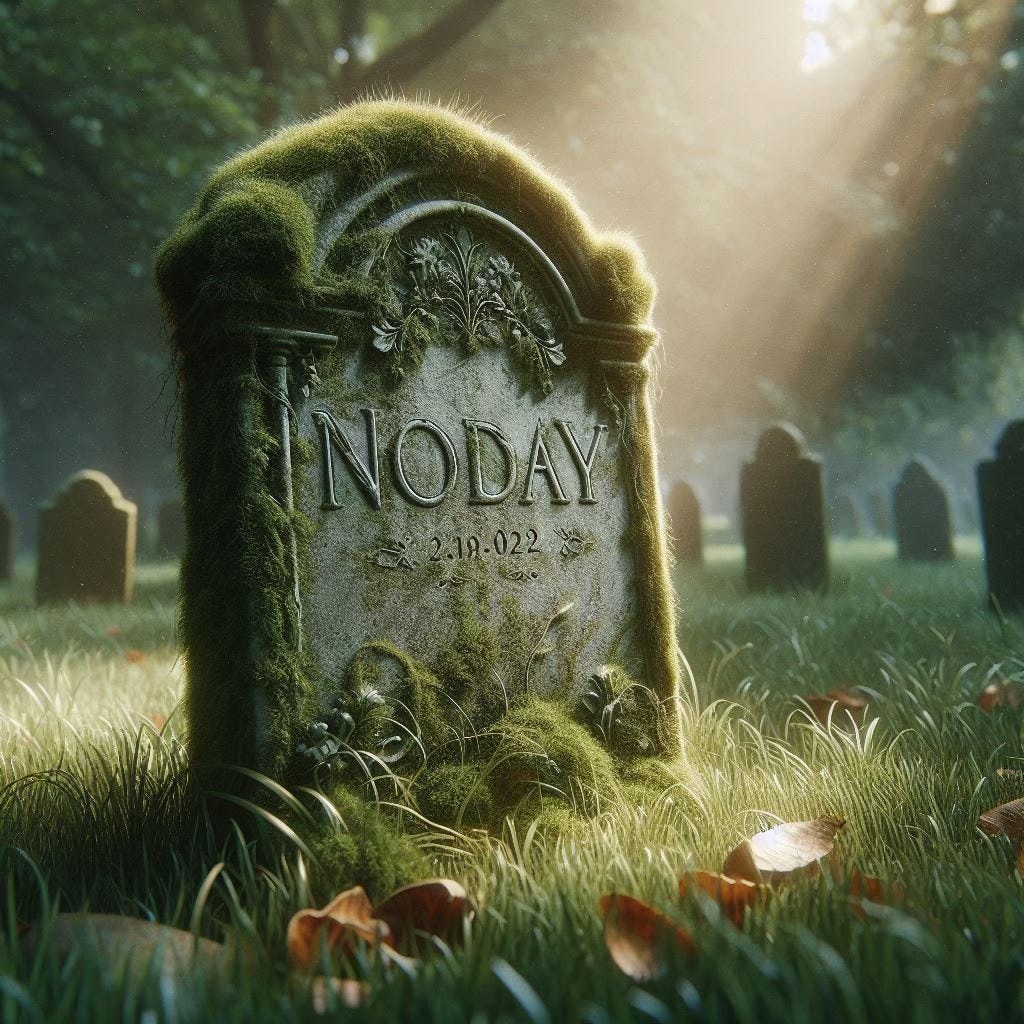
No One Died All Year
By Darren Johnson
Journal & Press
Fourteen years ago in 2028, our newspaper was the first to break the No One Died All Year (NODAY) story, at least here in the USA. We should have won a Pulitzer for that, but didn’t.
Our then obituary freelancer, Thurman Harris (RIP), called me on Jan. 4, 2028, and said, “Don’t you think it’s odd that we haven’t had an obituary since Christmas? Normally, people drop like flies around the holidays.”
I blew him off. I figured he was just complaining because he wasn’t getting paid, as he had worked on a per-story (per-death) basis. But then the next day he called me again, and said that he’d read a plethora of other newspapers, and even called area funeral parlors — no deaths. I had him call hospitals. You know the story. No one was dying. The last reported death in our region was just before midnight on New Year’s Eve, the drug overdose of billionaire virtual-world inventor Hal Robbins, 37, at a high end hotel in Saratoga Springs, NY.
We reported this on Jan. 6. New York City media picked up the story, and then it went national, as, it turned out, this was happening everywhere. No one was dying.
You know the rest of the story.
China used its overwhelming population advantage to invade Taiwan and then Japan, as soldiers were impervious to any wounding. Foes captured were put into slave labor camps.
Japan launched a nuke into Beijing, but, while all of the buildings and property were obliterated, the people remained standing, oftentimes their homes or cars melting around them.
One would have thought crime would have become rampant in the US, as criminals wouldn’t have to fear being killed during the commissioning of their crimes, but it turned out everyone was just confused, and the crime rate actually went down 37% in our country.
President Trump was supposed to leave office by Jan. 20, but famously stayed on, with congress’s blessing, as he had become known as a peacemaker in the world. Before NODAY, he had been rated one of the worst presidents in US history by historians, though they tend to lean left. But after negotiating world peace and the withdrawal of Chinese troops from Japan, historians elevated his ranking to “middling,” just above Chester A. Arthur.
NODAY is a time we haven’t forgotten, though people who were just children then or not yet born may not understand how unusual that year was, and the aftermath. Because, at the time, we didn’t know NODAY would end with the end of the year — we thought maybe we all were immortal now. Drunken frat boys started bungee jumping into the Grand Canyon.
But at midnight Jan. 1, 2029 (depending which time zone one lived in), everyone who should have died in 2028 just instantly died. One hundred million people all in a day just keeled over. This included those people who had been nuked in Beijing eleven months earlier and thought they were invincible, along with anyone else shot, stabbed, had a heart attack, etc., any time in 2028.
The hospitals and funeral parlors — and obituary sections — had to quickly get back in service — many of their workers had found other jobs — but, since then, after the huge shock of 100 million instant deaths, people have just been dying at a relatively normal pace.
While a lot of people think they know what caused NODAY, the reality is, we may never know. The three common theories are:
We live in a simulation and this was either a computer glitch, hack or an AI experiment. Maybe Hal Robbins was the mastermind of our reality, some suspect, and his death disrupted normal operations.
Space aliens, like the Malachian 37s who have since publicly visited and made themselves known before disappearing a few years ago, were able to manipulate human physiology, using chemicals dispersed by air or water, to help us stave off death.
For those with a religious bent, God did this to teach humanity a lesson, though we don’t quite know what that lesson is. Perhaps for nations to get along and work out their differences?
While I can accept Simulation Theory and even the idea of God intervening, I don’t buy the space alien theory because of the exactness of NODAY being confined to one year. Why would aliens time it like that, and how could they use chemicals that would so neatly activate and expire all at the same time, 365 days apart? (Or make it 366, as they even accounted for the Leap Day!)
Prof. Catherine O’Dwire, an astrophysicist at SUNY Adirondack, suggests that it may have to do with the Earth’s rotation around the sun, and that perhaps we were in a temporal zone that spanned one rotation. Each annual rotation around the sun is not exactly the same, and in 2028 we entered a rotating track that is in a different space-time dimension, she theorizes; so maybe the NODAY phenomenon had happened before, if the Earth had entered that track before — before recorded history — and maybe it might happen again someday.
Whatever the case, NODAY was surely an odd time, and hopefully we learned, if it does happen again, don’t skydive without a parachute — you may not die just yet, your face planted in a football field — but oh what a big ouch at midnight on the following Jan. 1!
Nice!